
Reviewed · OSTIA ANTICA TOURS
Rome: Ostia Antica Archaeological Park Ticket & Audio App
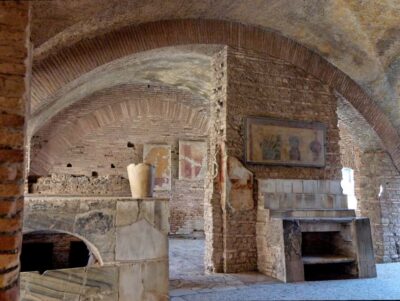
Ostia Antica is one of those rare Roman stops where it actually feels like the city got paused. Silt from the Tiber buried it for centuries, then protected it, so you can walk among well-preserved mosaics and frescoed rooms without the usual “only a few stones left” feeling.
I really like that this ticket is built for self-paced exploring, not a rushed checklist. You get a digital audioguide for the sites, and you can slow down for the details that make Ostia worth your time, like the town’s apartment blocks and seaside villas.
The only real drawback is the logistics are on you, and the site walking is serious. Paths are uneven, the ruins are extensive, and the walking loop can feel a bit confusing at first, especially if you rely on the route without a map.
Key things you’ll notice right away
- Silt-preserved streets and homes: centuries of river mud helped keep floors, wall art, and building shapes clear.
- Mosaics and frescoes everywhere: not just one highlight room, but a steady stream of decoration.
- Two-story apartment blocks and seaside villas: you see how different kinds of Romans lived.
- A whole set of connected sites: Ostia Antica plus Castle of Julius II, ship history in Fiumicino, and the ports and necropolis nearby.
- Digital audioguide that supports DIY pacing: helpful, but you may need patience to track exact spots.
- Turn your own photo into a postcard: a fun souvenir idea that is more personal than a typical print.
Why Ostia Antica feels like a time capsule, not just ruins
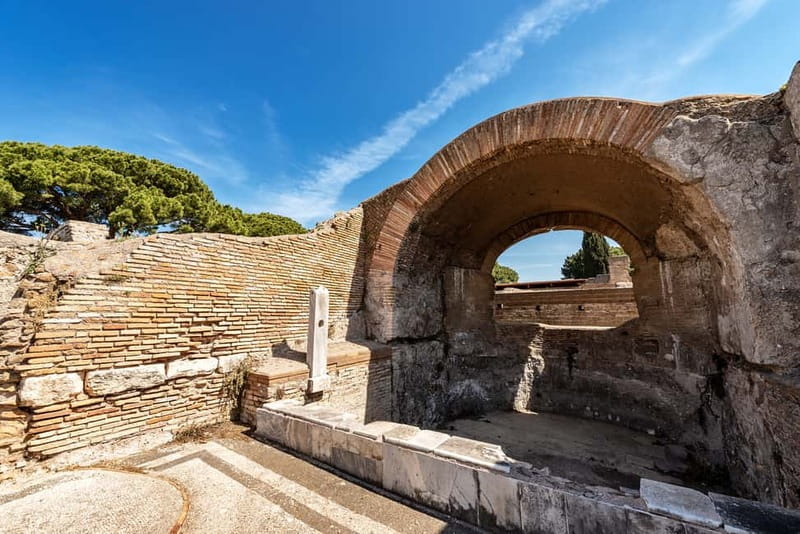
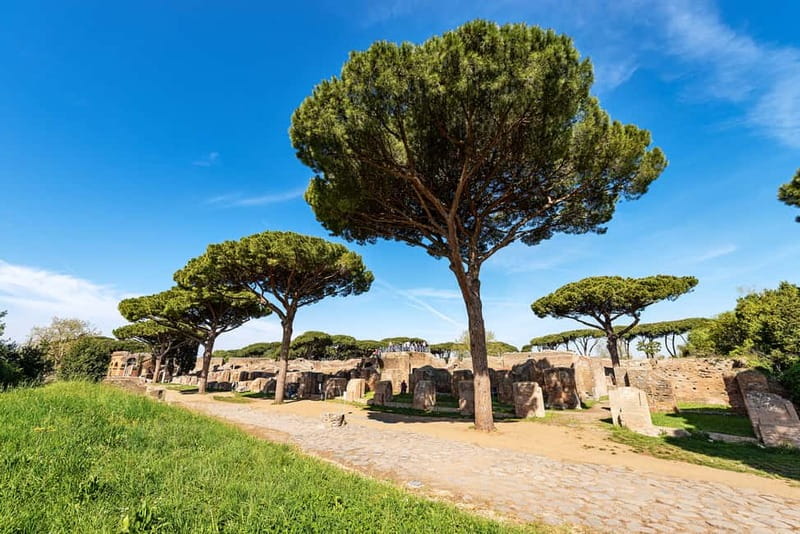
Ostia Antica sits just outside Rome, but it doesn’t feel like “another day trip ruin.” The reason is simple: the city was buried under silt from the river. When you’re standing in the remains of streets and rooms, you’re not just looking at layout, you’re seeing how surfaces and decoration survived.
It also helps that Ostia was a real working coastal city, not a one-season stop. According to legend, Ancus Marcius founded it as a colony on the mouth of the Tiber in 620 BC. That backstory gives you a mental anchor as you wander, because the place is connected to trade, travel, and the movement of goods.
For me, the best part is how the ruins explain themselves when you pace slowly. You notice the way buildings were organized, where people probably walked between spaces, and how the “home” and the “work” world overlapped in Roman life. It’s Roman daily living, not only big monuments.
More Ostia Antica trips from Rome:
- Ancient Ostia Antica Semi-Private Day Trip from Rome by Train with Guide
★ 4.5 · 579 reviews - From Rome: Ostia Antica Guided Half-Day Trip by Train
★ 4.8 · 486 reviews - Horse Sanctuary & Trail Ride in Ostia Antica
★ 4.5 · 276 reviews
Price and ticket value, what you actually get for about $27
At about $27 per person, this is a pretty strong value if you plan to do more than one site. Many Rome-area attractions charge for each museum and landmark separately, and here you’re paying once for an integrated admission that covers multiple places.
Your ticket includes entry to:
- Ostia Antica Archaeological Park
- Castle of Julius II
- Museum of Ships in Fiumicino
- Imperial Ports of Claudius and Trajan
- Necropolis of Porto on Isola Sacra
You also get a digital audioguide. Even if you’re not a big “audio person,” it helps you connect what you’re seeing with what those spaces likely meant.
One detail to double-check on your voucher: the info you’re given says valid for 8 days from first activation, but another note says 7 days from first admission. Either way, it’s in the “about a week” range, and the main benefit is flexibility. You’re not locked into a single morning window.
Where you start, and why the first 30 minutes matter
You begin by exchanging your voucher at the Ostia Antica ticket office. After that, you’re on your own with the ticket and audio. That’s part of the charm. No group herding. No forced pace.
Still, the first part of the visit is where people either get oriented or lose time. The ruins cover a large area, and the route around isn’t always obvious. If you show up without a plan, you can end up doubling back.
My advice is to take a moment right away to figure out how you’ll move through the park. Use the audioguide prompts, but also keep an eye on simple orientation cues. If you’re in summer heat, build in pauses early, not late.
And yes, there’s practical stuff: paths are uneven, and you’ll do a lot of walking. Comfortable shoes are not optional here, they’re the difference between enjoying mosaics and just wanting to escape.
Ostia Antica Archaeological Park, where the best details are the reward
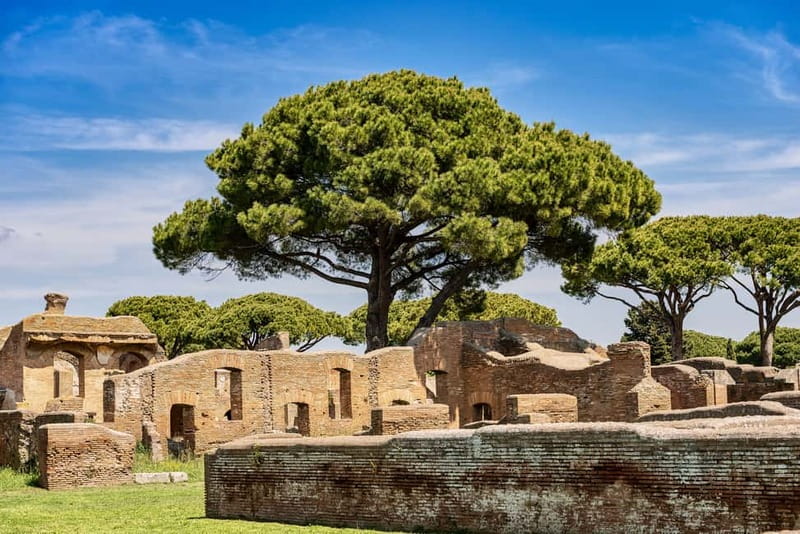
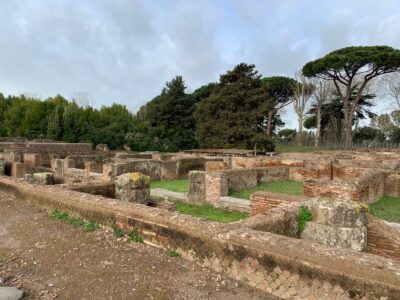
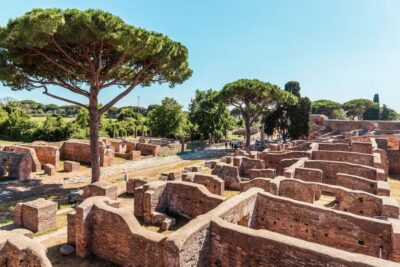
Think of Ostia Antica as a city you can wander through by choosing your own order. The archaeological park gives you streets and buildings that feel surprisingly legible, because the site preserves more than you might expect.
The “wow” moments usually come in layers:
- You see the streets and building shapes.
- Then you spot the decoration, especially mosaics and fresco traces.
- After that, you start noticing the “life patterns,” like where people lived and how they moved between spaces.
The experience is especially good if you like architecture and domestic spaces. You get to explore apartments and villas, not just open-air fragments. Two-story Roman apartment blocks show how dense and organized city living could be, even for a place outside Rome.
And because the site is well preserved, you can compare spaces. It’s easier to imagine the routines when you’re looking at rooms that still hold their visual structure.
A few more Rome tours worth comparing
- Rome: Colosseum & Forum with Audio Guide App -Optional Arena
★ 4.2 · 24,770 reviews - Rome: St. Peter’s Basilica & Dome Entry Ticket & Audio Tour
★ 4.2 · 7,537 reviews - Vatican & Sistine Chapel Ticket with Optional Audio Guide
★ 4.1 · 5,405 reviews - Rome: Colosseum, Forum, & Palatine Hill with Audio Guide
★ 4.3 · 4,591 reviews
Apartment blocks and the seaside living of Procoio
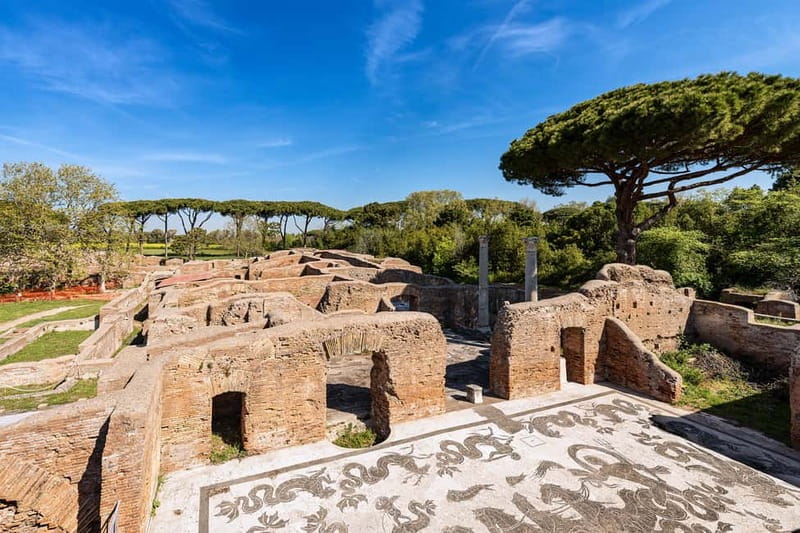
One of Ostia’s best ways to understand Roman class differences is that it’s not only one type of residence. In the park, you can look at apartment blocks and then shift to the seaside villas of Procoio.
The apartment blocks help you picture daily urban life. You’re seeing stacked living spaces, which makes the city feel crowded and practical. It also gives you a better sense of how Romans lived close together, without needing a “single-family” villa to define comfort.
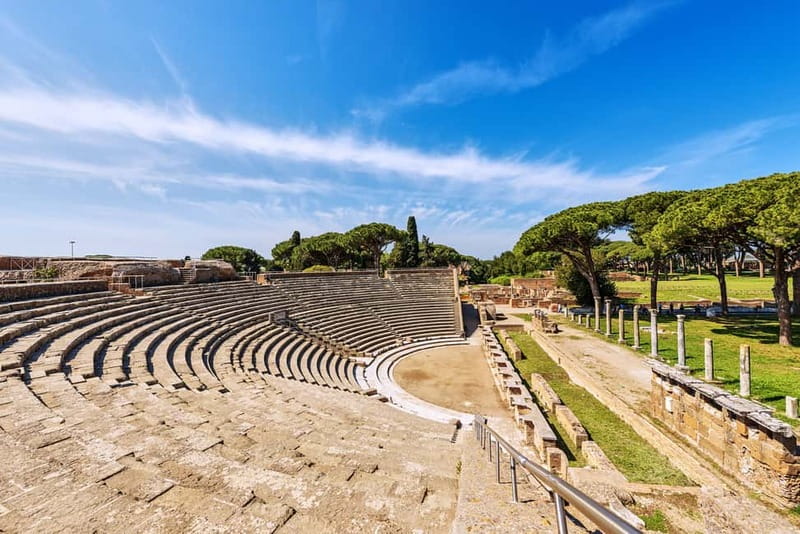
Then Procoio changes the mood. The seaside villas connect you to leisure and spectacle, especially around the larger complex areas. You’ll encounter a large bath complex and an amphitheater linked to the theatrical culture of the time.
When you put these two types of housing side by side in your walk, the city becomes more than a list of ruins. You feel the range of Roman life in one area.
The Procoio amphitheater with stone theatrical masks
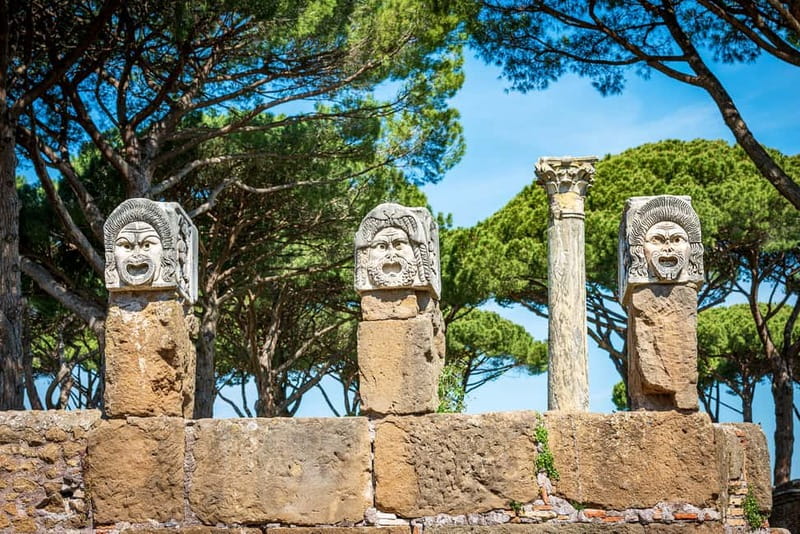
This is the kind of detail that makes you stop and actually look around. In the Procoio area, the amphitheater is lined with striking stone theatrical masks.
It’s not just decoration. It’s the visual language of performance. When you imagine the crowds gathered here, the masks act like a clue to what people expected from the entertainment.
In practice, I suggest you slow down at this stop. Give yourself a few minutes to look at the masks from different angles if you can. This is one of those spots where the “photograph quickly” approach can make you miss what’s special.
Castle of Julius II, a different stop from the ruins
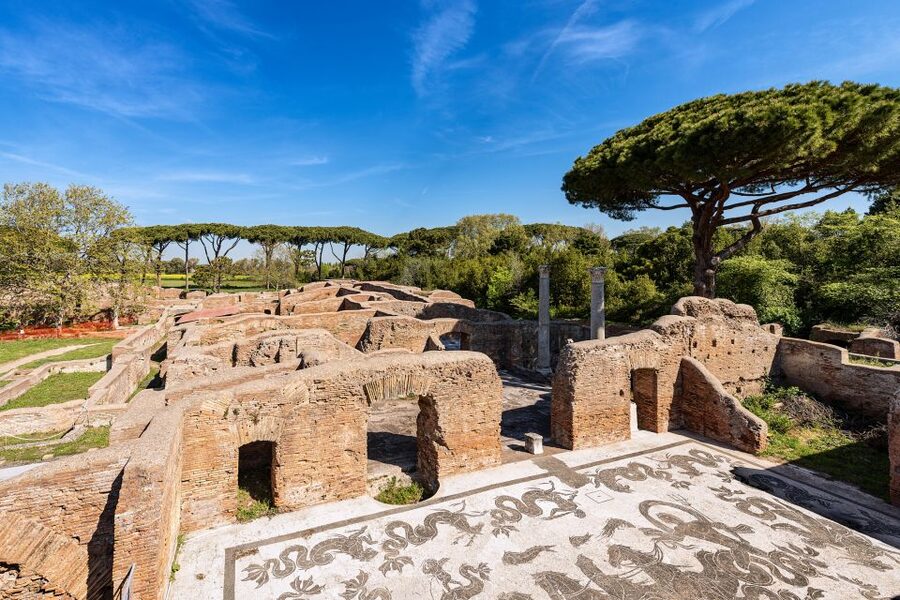
After Ostia Antica’s street-level archaeology, the Castle of Julius II gives you a new kind of perspective. Instead of domestic rooms and mosaics, you shift from ancient living spaces to a later structure tied to the castle tradition of the region.
This is where your integrated ticket starts to feel smart. You’re not only collecting ruins. You’re also building a sense of how the area stayed important, long after the ancient city fell quiet.
If you prefer variety, don’t skip this part. It helps break up a long day of walking in the park.
Museum of Ships in Fiumicino, Roman trade in real terms
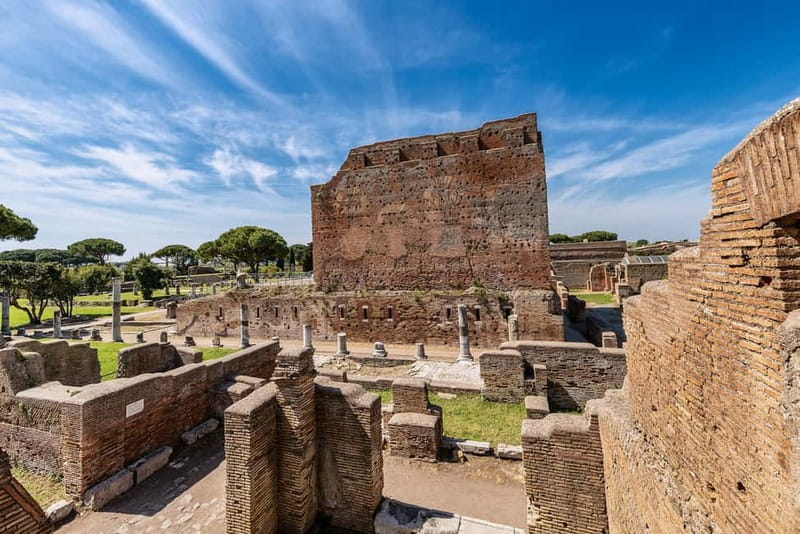
The Museum of Ships in Fiumicino answers a question that keeps popping up while you explore Ostia: how did this place connect to the wider world?
Because Ostia was a coastal city at the mouth of the Tiber, the story is about movement, shipping, and bringing goods in and out. A ship-focused museum fits that reality. It turns the “coastal setting” into something tangible.
Even if you’re not a nautical history person, you’ll get more out of the ports and necropolis later. You start to connect the dots between where ships arrived and where people worked and lived.
Imperial Ports of Claudius and Trajan, where Rome handled the flow
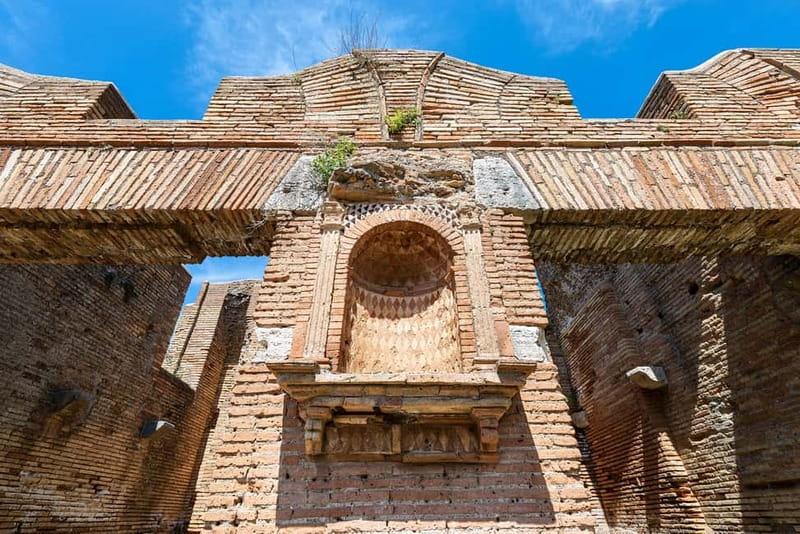
The Imperial Ports of Claudius and Trajan are a natural continuation of the ship museum. This is where the Roman city’s importance shows up in infrastructure.
When you stand in port-related spaces, you’re thinking about logistics: arrivals, departures, and the systems that kept Rome supplied. In a normal museum, that idea can feel abstract. In an archaeological setting, it feels grounded.
If you’re pairing sites in one day, I’d do it like this: ship museum first to set the context, ports next to see how that context played out in stone and space.
Necropolis of Porto on Isola Sacra, a quiet counterpoint
By the time you reach the Necropolis of Porto on Isola Sacra, your brain is ready for a change in pace. It’s a different Roman mood. Less about daily life in houses, more about how communities marked the end of life.
This stop matters because it completes the picture. Trade and entertainment tell one side of Roman culture. The necropolis shows the other side: memory, family, and how Romans dealt with mortality.
It also gives you a strong emotional contrast as you move through the integrated set of sites. If you’re only there for mosaics, you’ll miss some of the value. Give this part time, even if you prefer the brighter home-and-villa areas.
Digital audioguide and the photo-to-postcard feature
The digital audioguide is included, and it’s clearly meant to support self-guided exploring. It’s useful when you want a quick explanation of what you’re seeing without needing to hunt for a signboard explanation every time.
The tradeoff is that audio can make location tricky at moments. The park is large, and individual sites can be hard to track from your exact spot. If you notice that happening, slow down. Look for visual anchors, then let the audio catch up.
The other fun feature is that you can turn one of your own digital photos into a unique postcard to send to friends or family. It’s a more personal souvenir than the usual ticket-print habit. Plus, it gives you a reason to frame your photos intentionally, rather than snapping and moving on.
To use it smoothly, keep your phone charged. You don’t want battery anxiety while you’re trying to send off a postcard.
Practical tips for an all-day walk: shoes, water, and getting unlost
This is a full-day experience for many people, mainly because the ruins are extensive and you’ll want time at the highlights. In hot months, plan for heat and hydration. Bring water and take breaks instead of pushing through.
Sturdy shoes matter because paths are uneven. Even if the ground doesn’t look dangerous, Roman stone and archaeological terrain can be tiring over hours.
Navigation is the big mental challenge. The route around can be hard to follow, and it’s easy to lose your sense of direction even with a guidebook style approach. My go-to strategy is simple: pick a couple of “must-see” areas, then let the rest be bonus. You’ll still cover a lot, and you won’t feel crushed if your route gets messy.
There’s also a cafe on-site, but it can feel hard to find. If food is part of your plan, don’t treat it like a last-minute rescue. Know roughly where you’ll aim for a break before you get too far into the park.
Who this integrated ticket is best for
This ticket works best for you if you like architectural details and you want time to wander. If your ideal Rome day is less line-waiting and more looking closely, Ostia Antica is a strong fit.
It also suits couples and solo travelers who are happy moving at their own pace. Since transportation is not included, you should already be comfortable planning how you’ll get between the different areas, especially if you’re pairing Ostia with Fiumicino and Isola Sacra.
If you want a place that’s heavy on mosaics, frescoes, and preserved rooms, this is the kind of Roman site that delivers. And if you like the idea of learning through audio while you explore, the digital audioguide is a big part of the value.
If you hate walking long distances or you need perfectly smooth paths, this might feel like too much. The site terrain is uneven, and you’ll earn every view.
Should you book the Ostia Antica Archaeological Park ticket?
Yes, you should book it if you want a more atmospheric Roman experience than the usual big monuments. The ticket value stands out because you’re not just paying for one location. You get a connected set of sites that tell the story from city life to ports to burial grounds.
Book it if you’ll actually use the audioguide and give yourself time. This is not a “see it fast” stop. The best parts are the small details, mosaics, frescoed surfaces, and domestic layouts that are easy to rush past.
Skip it only if you want guided group pacing, or if long uneven walking is a deal-breaker for you. Also, because transportation is not included, make sure you have a workable plan for moving between the included areas.
If you get those two things right, you’ll come away feeling like you saw something truly Roman, not just a famous set of stones.
More Self-Guided Tours in Rome
- Rome: Castel Sant’Angelo Skip-the-Line Ticket & Audio Guide
★ 4.4 · 3,500 reviews - Rome: Pantheon Priority Entry Ticket & Audio Guide App
★ 4.1 · 3,234 reviews - Rome: Colosseum Access with Official AI App & Arena Option
★ 3.5 · 2,964 reviews - Rome: Colosseum Experience with Audio Guide and Arena Option
★ 4.2 · 2,200 reviews
Recently reviewed around Rome
- Ancient Etruscan Civilization Tour from Rome★ 5.0 · 16 reviews
- Colosseum with Arena Floor Express Guided Tour★ 3.5 · 22 reviews
- Private Tour – Ancient Ostia★ 5.0 · 42 reviews
- PRIVATE Appian Way and Lake Albano Ebike Tour with Italian Lunch★ 5.0 · 12 reviews
- Ancient Appian Way and Roman Countryside E-Bike Tour★ 4.5 · 13 reviews
- Ancient Appian Way PRIVATE Bike Tour★ 5.0 · 89 reviews
- Catacombs and Hidden Underground Rome: Small Group Max 6 People★ 5.0 · 293 reviews
- Amalfi Coast Day Trip from Rome by High-Speed Train★ 4.5 · 162 reviews
Ostia Antica Tours, compared.
Ancient Ostia Antica Semi-Private Day Trip from Rome by Train with Guide
Read our review →

Browse the lists this tour appears in