
Reviewed · OSTIA ANTICA TOURS
From Rome: Ostia Antica Guided Half-Day Trip by Train
Ostia Antica is interesting because it shows you the working Roman world right outside Rome, not just temples and tombs. I love that you walk down Decumanus Maximus streets like a normal person in the Roman Republic, and I also love the mix of public life stops, from the Baths of Neptune mosaic to the amphitheater. One consideration: the site is large and you are on your feet for most of the 3-hour guided walk.
The other thing to plan for is practical timing. You’ll ride trains to get there, and at the end you can either stay in Ostia or return to Rome, but the return can be unescorted if you go on your own.
Key things to know before you go

- A small group up to 12 helps you actually hear your guide and ask questions
- Train access from central Rome makes this a low-stress day trip
- Neptune’s Baths mosaic is the kind of art you remember because it still looks crisp
- Amphitheater seating helps you picture how crowds fit in a real Roman venue
- Forica public washrooms is one of the most human stops in any Roman ruins visit
- Optional beach time in Ostia lets you turn history into a relaxed afternoon
Why Ostia Antica feels different from the big-ticket ruins
If you know Rome only through its monumental sites, Ostia Antica adds an important missing piece. This was a port city that supported Rome’s daily needs, commercial life, and military movement. That means the ruins you see are not just “what rulers built,” but also where goods moved, where people ate, where they worked, and where they cooled off.
What makes the experience work is the way the tour steers your eyes. The guide points out street lines, building functions, and everyday details so you start connecting the dots. In particular, the best guides bring the whole thing down to scale, with explanations that make you feel like you are moving through a real city block, not looking at an empty archaeological park.
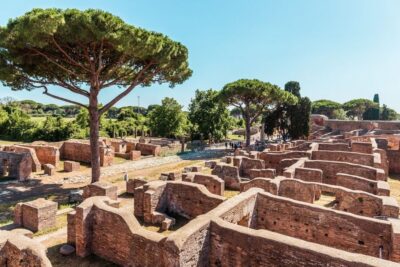
A key advantage is the feel of the place. It is generally quieter than the most famous Roman sites, which matters because Ostia is big. When fewer people are around, you can slow down, look longer at mosaics and carvings, and actually read the “story” the buildings tell.
More Ostia Antica trips from Rome:
- Ancient Ostia Antica Semi-Private Day Trip from Rome by Train with Guide
★ 4.5 · 579 reviews - Horse Sanctuary & Trail Ride in Ostia Antica
★ 4.5 · 276 reviews - Ostia Antica Semi Private Tour from Rome
★ 5.0 · 238 reviews
Getting from Rome to Ostia Antica, and finding your group fast
The tour runs on train, and that is a big part of the value. You get round-trip train tickets included, plus an entry ticket and a guide. There is no hotel pickup, so you start by reaching the meeting point yourself.
Meet at Cafe Piramide near the Piramide metro area (Metro Line B, blue line). If you face the Piramide metro, stop on the right-hand side is the café, visible from the tracks and the train exit. You’ll recognize it by the white umbrellas outside. City Wonders guides hold a sign with the tour name, which makes the meeting part straightforward even if you are a little early.
From there, the train ride is short, around 15 minutes to get out to Ostia Antica. Once you reach the station, the walk to the archaeological area is quick, usually under 5 minutes, so you are not stuck dragging your daypack across the countryside.
Practical tip: wear shoes you can stand in for hours. Ostia is mostly outdoors, and the ground can be uneven. Comfortable, grippy soles make a noticeable difference.
Decumanus Maximus: walking the main street like a Roman citizen
The heart of your guided portion is the walk through the ruins, especially along the main thoroughfare, Decumanus Maximus. This is where your guide’s storytelling really matters. A street sounds simple, but here it is packed with meaning.
On the main corridor, you can see how a city organizes itself: movement of people, locations of shops and taverns, and the way buildings relate to the road. Your guide points out statues that line the walkways, helping you understand that this was not just a utilitarian transit route. It was also a public space where identity, art, and civic pride showed up as you moved through daily life.
What I like about this stop is how it changes your “mental map.” Instead of viewing isolated structures, you start to feel the rhythm of the place. Even if your Roman history is rusty, the guide breaks down what you are looking at, building a clear picture of the Roman Republic era port city.
One more bonus: Ostia’s ruins are often easier to process than some other famous sites. Pompeii can be overwhelming, because you see so much at once. In Ostia, the scale is still large, but the focus on port life and everyday buildings gives you a more grounded experience.
Baths of Neptune: mosaic art that still feels alive
The Baths of Neptune are a highlight for a reason. The structure itself gives you the “public building” feel, but the star is the mosaic, featuring Neptune with sea imagery and a chariot. It is impressively intact, which is rare in ruins. When you see it in person, it is easier to understand how Romans used art in places you visited for relaxation and routine.
I also like that this stop does not float in pure aesthetics. Your guide connects the mosaic to the bath experience, which helps you picture a real day in Ostia: someone arrives, runs errands, and then steps into a communal space where culture, gossip, and refreshment all overlap.
If you are the type who enjoys mosaics, this is one of the best “wow” moments on the route. If you are not, it still works because the bath complex shows how civic spaces were part of ordinary life.
More day trips out of Rome:
- From Rome: Pompeii, Amalfi Coast, and Sorrento Day Trip
★ 4.6 · 7,031 reviews - From Rome: Pompeii, Amalfi Coast and Positano Day Trip
★ 4.6 · 6,620 reviews - Pompeii, Amalfi Coast and Positano Day Trip from Rome
★ 4.5 · 6,250 reviews - Pompeii and Mount Vesuvius Day Trip from Rome with Pizza Lunch
★ 4.5 · 6,151 reviews
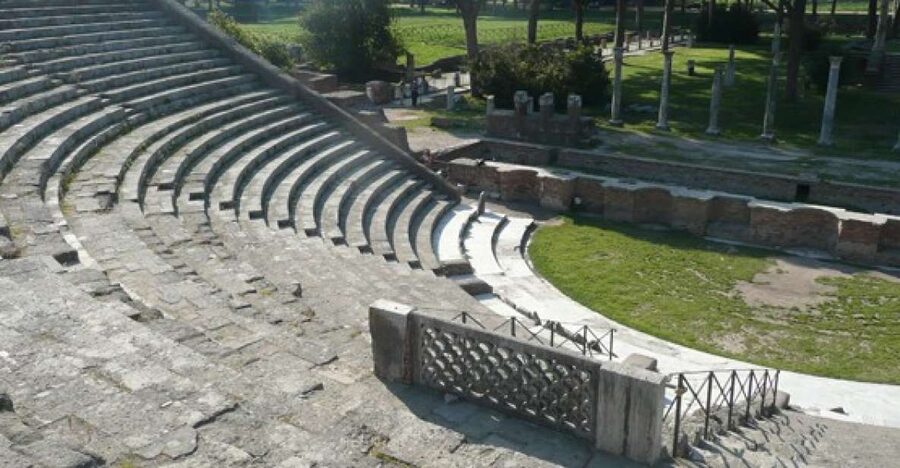
The amphitheater seats: 3,500 spectators in your imagination
Next up is the amphitheater. This is where you start imagining noise, crowds, and timing. The amphitheater was built for about 3,500 spectators back in 12 BC, and that number helps your brain size up the audience.
As you take your place in the stands, the ruins do a clever thing: they turn into a practical viewing platform. You can look out and understand sightlines, not just scenery. Your guide uses that to help you picture an event schedule, the way cheering would have filled the air, and how entertainment fit into a working port city where people were always busy.
A good guide here makes the difference between seeing seats and understanding the social function of the venue. You’ll usually leave this stop thinking, not just seeing.
Forica public washrooms: the most human part of Ancient Rome
If you want one stop that feels oddly modern, it is the Forica, the communal washrooms. This is the place people often remember long after the “bigger” structures blur together.
The Forica has a marble bench with 20 well-spaced holes set along multiple walls in a large open room. Sitting in the space, with the guide’s explanation, turns it into a lesson in daily infrastructure. This was not private comfort. It was public order, sanitation routines, and social life all at once.
It is also the best reminder that Roman cities ran on systems. Even the boring stuff was designed and managed. That is the kind of detail a guided tour helps you catch, because on your own you could walk right past the meaning of a bench and miss why it matters.
Bring your imagination, not just your camera.
The rest of the ruins: taverns, warehouses, and thermal life
Beyond the “big stops,” you’ll also pass through areas that show how the city functioned day to day, including well-preserved remains connected to commerce and leisure. You may see structures tied to taverns, thermal baths, warehouses, and theaters.
Your guide keeps connecting these buildings back to port life and the rhythm of the city. In other words, you’re not just learning dates. You’re learning jobs. Who used which building. What a visitor might do in the morning. Where someone would go after work.
Another thing you may notice with a good guide is pacing. The group moves enough to see the key areas, but you get pauses for a toilet break and snack or drink at the snack bar. That matters because the tour length is a steady mix of walking and explanations, and being able to reset keeps you focused.
After the tour: stay in Ostia or go to the beach
One of the best parts of this setup is choice. When the guided portion ends, you can stay in Ostia Antica and explore more on your own, or keep going into the modern city area. Many people also add a beach stop because it is nearby and makes the half-day feel like more than just ruins.
If you like the idea of continuing without rushing, the timing can be a gift. You are not boxed into a nonstop bus-style schedule. You can linger, then decide how much beach you want.
A practical note: if you want the museum that is inside the site area, plan your visit carefully. In winter, it can close early, around 1:30 pm, so do it sooner rather than later if you are traveling in colder months.
And if you choose to return to Rome with the guide, you can ride back together. If you go on your own, you still get return train tickets, but the ride back is unescorted, so you’ll want to keep your bearings.
Price and value: is $58 worth it for 4 hours?
At $58 per person for a 4-hour experience, the value comes from what you don’t have to plan yourself. You get:
- Return train ticket between Rome and Ostia Antica
- Entry ticket for Ostia Antica
- A live English guide
- A small group size, limited to 12 participants
If you tried to recreate this on your own, you would spend time figuring out train timing, buying tickets, and then trying to interpret the ruins without a trained guide to point out what matters. Here, the guide’s job is to do the interpretation for you, especially at the places where function is not obvious at first glance, like the Forica or the bath complexes.
The group limit is also part of the value. With a smaller crowd, you are not constantly stuck behind someone’s phone camera. You can hear directions and ask follow-up questions without feeling like you are interrupting a conveyor belt.
Is it a bargain compared to a full-day ticket? It depends on your style. If you love Roman ruins and want context, paying for the guide is worth it. If you prefer self-guided exploring with a guidebook, you might feel the cost more. But for most people, the guided structure is what makes Ostia click.
Guide quality matters more than people expect
Ostia Antica is a place where the difference between a good guide and a weak one is obvious. The site is large, and the story could easily become a list of buildings. The best guides turn the same materials into a readable city.
You’ll see that in the way guides are described by past participants, with names like Rob, Cat, Alberto Terrasi, Liv, Laura, and Catarina showing up repeatedly. The common thread is delivery: clear explanations, a pace that keeps you moving but does not rush the key stops, and humor or light acting that helps you visualize port life and everyday routines.
One detail I really like from the guide approach is that you usually get enough small pauses to wander and catch your breath. Not just one long stop where everyone disperses, but short moments that keep the tour from feeling like a treadmill.
Also, if you care about logistics, it helps that the guide handles group tracking and train instructions. That is not glamorous, but it keeps the day smooth.
Who should book this tour, and who might skip it
This is a strong match if you:
- Want a less crowded alternative to the biggest Roman ruins
- Like understanding what regular Romans did, not just what emperors built
- Prefer half-day sightseeing with a clear structure, train included
- Appreciate mosaics and public-life spaces, like baths and washrooms
You might consider a different plan if you:
- Need full wheelchair accessibility, since the tour is not suitable for wheelchair users
- Want to travel with a baby stroller, since baby strollers are not allowed
- Are looking for a totally self-directed day with no guide and no fixed stops
If you are traveling with kids, the tour can still work because it keeps moving and uses everyday explanations. Just keep expectations realistic for walking and outdoor heat.
Should you book this Rome to Ostia Antica guided train trip?
Book it if you want the fastest way to turn Ostia Antica into a story you can remember. The combo of train simplicity, a small group, and a guide-led walk through the port city’s daily-life sites makes the half-day feel purposeful, not rushed.
I’d especially recommend it over a self-guided attempt if you care about understanding what you are seeing at the Baths of Neptune, the amphitheater, and the Forica. Those stops are exactly where context matters most.
If you are on the fence, think about this: Ostia Antica is right outside Rome, but it is easy to miss the meaning when you go without help. This tour is designed to make the ruins readable, then give you time to linger on your own or head to the beach.
FAQ
Where do I meet for the Ostia Antica guided trip?
Meet at Cafe Piramide. If you face the Piramide metro (Line B, blue line) stop on your right-hand side is the cafe in view of the train tracks. Look for the white umbrellas outside. The guides hold a City Wonders sign.
How long is the tour from Rome?
The experience runs for about 4 hours total. The guided time at Ostia Antica is about 3 hours, with train rides before and after.
What is included in the price?
The price includes the return train ticket from Rome to Ostia Antica, the Ostia Antica entry ticket, and a live English guide.
Is there a toilet break during the tour?
Yes. There will be a toilet break with time for a snack and/or drink at the snack bar.
What happens at the end of the guided portion?
The tour service ends back in Rome at the Piramide Metro Station around 1:00 PM. You also have the option to remain in Ostia Antica and the modern city, or go to a nearby beach.
Can I return to Rome with the guide?
If you prefer, you can join the guide on the train back to Rome. If you go on your own, the return journey is unescorted, even though train tickets are provided.
What should I bring for the day?
Bring comfortable shoes. Also pack a towel and beachwear, plus sports shoes, especially if you plan to add beach time.
Is the tour wheelchair accessible, and are strollers allowed?
No. The tour is not suitable for wheelchair users. Baby strollers are not allowed.
More Trips by Train from Rome
- Rome to Pompeii Guided Tour with Wine & Lunch by High Speed Train
★ 5.0 · 1,379 reviews - Rome: Pompeii Tour with Wine and Lunch by High Speed Train
★ 4.8 · 485 reviews - Venice Day Trip from Rome by High-Speed Train with Happy Hour
★ 4.5 · 445 reviews - From Rome: Day Trip to Venice by High-Speed Train
★ 4.6 · 352 reviews
Recently reviewed around Rome
- Rome: Castelli Romani Hop-on and Hop-off Tour★ 4.9 · 32 reviews
- Rome: Food Tour near Vatican City with Wine★ 4.8 · 100 reviews
- Rome: Scavenger Hunt Self-Guided Tour★ 4.6 · 15 reviews
- Hidden Rome: Small Group E-Bike Tour with Street Food Stops★ 4.9 · 144 reviews
- Rome: Highlights Tour in Golf Cart★ 4.9 · 28 reviews
- Rome: Hop-on Hop-off Bus Tour and Colosseum Experience★ 3.4 · 163 reviews
- Rome: Guided Haunted Rome Ghost Tour with Dowsing Rods★ 4.8 · 63 reviews
- Rome: Highlights Photo Shoot for Memorable Moments★ 5.0 · 32 reviews
Ostia Antica Tours, compared.
Ancient Ostia Antica Semi-Private Day Trip from Rome by Train with Guide
Read our review →

Browse the lists this tour appears in