
Reviewed · GOLF CART TOURS
Rome: Golf Cart Tour of the Eternal City
Rome has a special way of rewarding slow looking, then punishing you for being late to everything. This open-air golf cart tour is interesting because it mixes fast transport with enough photo stops to make the highlights feel real, not rushed. You get to roll through neighborhoods you might miss on foot, while an English-speaking guide keeps the story clear.
I like that the tour is group-limited, so your experience feels more tailored than a big bus shuffle. I also love the practical flow, from the leafy Villa Borghese start to Rome’s most iconic “you have to see this” moments. One possible drawback is that, depending on the guide and cart setup, some people may find it tricky to hear details during driving time.
If you’re okay with lots of short stops and you want a smart orientation to the city in one afternoon, it’s a strong pick. If you want long museum time or deep, uninterrupted explanations at each site, you may feel the time squeeze.
Key highlights in plain terms
- Private group feel with only your party participating
- Hotel pickup from central Rome, then easy drop-off back to the meeting point
- Photo-friendly pacing, with enough time to step out at major stops
- A tight route that hits Villa Borghese, Piazza del Popolo, Augustus, the Pantheon, and more
- English-speaking guides with personality, jokes, and history context (names you might get include Hadi, Francesco, Pietro, Marco, Sabrina, and Gianluca)
- Mobility support by design, since you cover distance without walking every meter
Why Rome by golf cart feels like a smart shortcut
Rome’s main sights are spread out like they were designed to exhaust your legs. A golf cart tour solves that without pretending you can see everything by staring at a screen. You move through narrow streets and get quick access to viewpoints that would be a slog to reach on foot.
The best part is that you still get to look. You’re not just cruising past landmarks; you stop, step out, and snap photos in real places. Plus, the guide’s job is to keep you oriented, so you start understanding how Rome is laid out: hills, ruins, grand piazzas, and the routes that connect them.
More golf cart tours of Rome:
- Rome by Golf Cart Private Tour: Beyond the Landmarks
★ 5.0 · 4,361 reviews - Rome on a Golf Cart Semi-Private Tour Max 6 with Private Option
★ 5.0 · 2,502 reviews - Rome Highlights by Golf Cart Private Tour
★ 5.0 · 2,379 reviews
Hotel pickup and the start that actually matters
The tour is built around convenience. A driver-guide is waiting at the main entrance of your central Rome hotel. If your hotel is outside that central area, you’ll meet the group at a designated central location instead.
This matters because Rome pick-up problems are real. There is at least one cautionary note from people who struggled to meet the guide last-minute, including confusion about addresses. If your hotel is hard to find or tucked into a side street, double-check the exact pickup instructions in your confirmation and write down a backup meeting spot.
The pacing: 3 hours, lots of stops, and how to use your time well
This is an approximately 3-hour experience, so you should expect quick transitions. Some sites get a short pause, around 5 to 10 minutes, while others get a slightly longer look. You’ll be on and off the cart often, which is great for seeing a broad set of highlights in a limited window.
Here’s the trick to getting value out of a tour like this: plan your personal priorities before you leave. If you want the Pantheon interior, don’t wait until the last second to ask. If Piazza Navona is your favorite photo spot, be ready to walk a few steps from the cart to get the framing right.
Also, if you’re sensitive to audio, keep your expectations practical. A few people reported that it could be hard to hear the guide while moving, depending on whether the cart has speakers or a sound system. If that’s a concern for you, ask when you meet the group how audio works on the cart.
Villa Borghese Gardens: where the tour starts with green calm
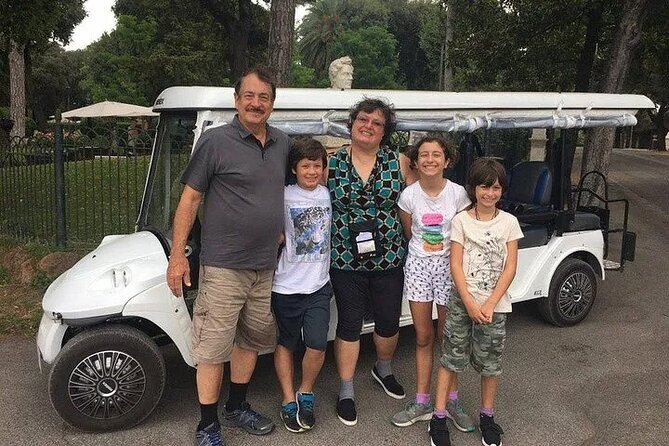
Starting at Villa Borghese Gardens is a smart move because it breaks the day into two moods: quiet greenery first, then grand city power. This park is enormous, with lakes, fountains, sculptures, and areas that feel like a world away from the traffic below.
You get a short stop, and that’s perfect here. Use the time to reset your eyes. Even if you are not planning to go inside the museums, you can appreciate the scale and the way the park softens Rome’s edges.
A few more Rome tours worth comparing
- Rome: City Sightseeing Hop-on Hop-off Bus with Audioguide
★ 4.0 · 16,045 reviews - City Sightseeing Rome Hop-On Hop-Off Bus Tour
★ 3.5 · 5,446 reviews - Rome: Fettuccine Pasta Cooking Class in Rome’s City Center
★ 4.8 · 2,414 reviews - Vatican City: Vatican Museums & Sistine Chapel Entry Ticket
★ 4.3 · 2,185 reviews
Piazza del Popolo and the Pincio view energy
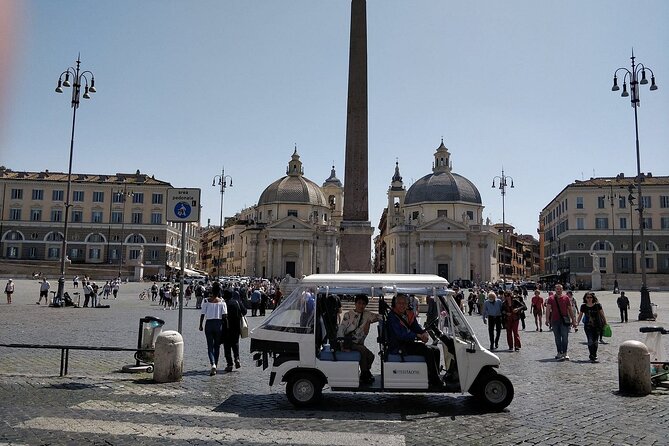
Next up is Piazza del Popolo, right in the middle of things. The space is defined by historic buildings around it, and it’s topped with the Egyptian obelisk, which is one of those objects that instantly signals Rome’s long layers of influence.
You’ll also get a taste of the hill-view setup around the Pincio, where panoramas make Rome feel like a collection of stages. The time is short, so focus on one or two angles rather than trying to photograph everything.
Mausoleum of Augustus: a quiet ancient anchor
Then comes a much calmer stop: the Mausoleum of Augustus. It was built in the era of the first Roman emperor, and what’s left still communicates how monumental the structure was. Today it sits in a peaceful park, which helps you understand why this part of Rome doesn’t feel like a nonstop spectacle.
This is a great stop if you like knowing the “why” behind what you see. The guide can connect the architecture to the political message of Augustus and the early empire. You won’t get long museum time here, but you’ll leave with a clearer mental map of Roman power.
Via del Corso: Rome’s main shopping spine (from a moving vantage)
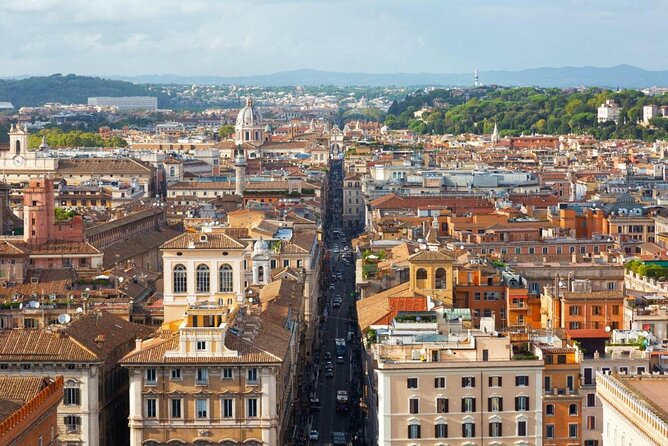
You’ll also pass through Via del Corso, a long, central shopping street that runs between Piazza del Popolo and Piazza Venezia. Even if you don’t plan to shop, it’s a useful place to understand how people move through Rome day to day.
This segment is more about perspective than lingering. From the cart, you can watch the street rhythm, spot major facades, and get your bearings for later wandering. It’s also where Rome’s modern life sits on top of ancient pathways, which is one of the city’s constant themes.
Marcus Aurelius Column and Piazza Colonna views
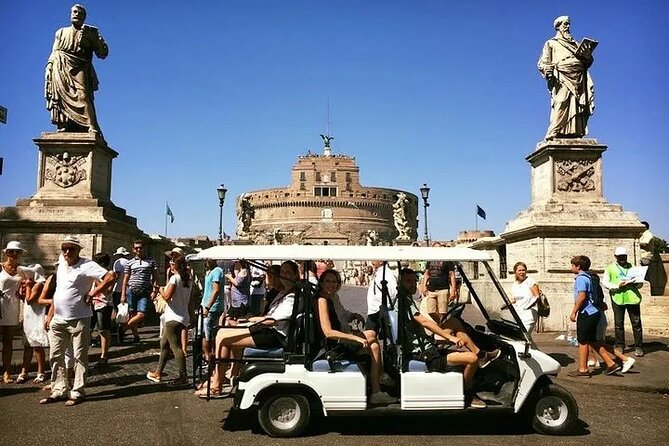
The Column of Marcus Aurelius is a standout because it’s both a monument and a story told in stone. The column is tall and carved with a continuous spiral relief about military campaigns, one of Rome’s best-preserved examples of that style.
You’re positioned in Piazza Colonna, which has lively baroque surroundings and real street energy. If you feel like it, the column’s interior staircase option can add a different angle, but with time tightness, decide fast whether you want the climb or a quick look at the base details.
Piazza Venezia and the Vittoriano: Rome’s big white centerpiece
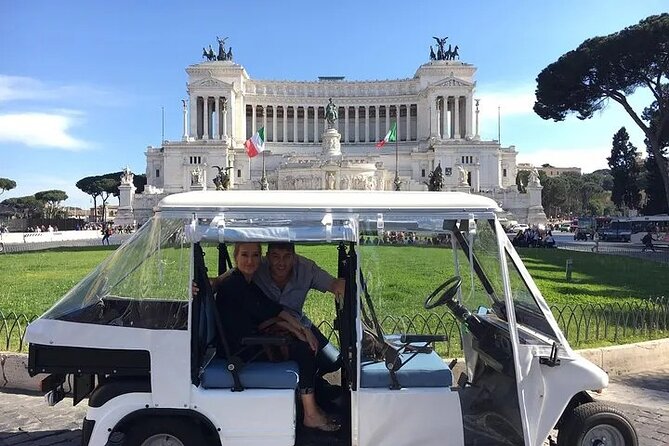
At Piazza Venezia, the Vittoriano dominates. It’s a massive white marble monument tied to King Victor Emmanuel II, and it’s impossible to ignore even if you have no interest in monuments.
This stop is valuable because it anchors you at a crossroads point of the city. From here, it’s easier to understand how the historic center connects toward the Forum area and beyond. You can also choose to view the museums or climb for panoramas if you want a higher-level look.
Trajan’s Market and the Imperial Fora museum complex
Mercati di Traiano, Museo dei Fori Imperiali brings you into a more intricate layer of ancient Rome. Trajan’s Market served commercial needs, but it’s famous for its architecture and its relationship to the Imperial Fora.
Even in a short stop, you can appreciate the curved façade and the way the complex connects above and below ground. It helps you understand that Rome’s “ruins” are not random piles. They were structured like a city within a city, with functions stacked and linked.
Circus Maximus: seeing the scale of ancient spectacle
Next is Circus Maximus, the ancient chariot racing stadium. It once held up to hundreds of thousands of spectators, and even without the full structure intact, the space gives you a strong feeling for scale.
Because much of the ancient fabric is gone, the tour style works well here. You can walk along the ancient track area and feel the open stretch of the venue. Then you get a sense of why this was prime public entertainment ground in ancient times.
Aventine Hill orange-garden calm and the keyhole legend
The Giardino degli Aranci, also called the Orange Gardens, is one of those stops that makes you glad you’re not stuck on a crowded sidewalk. It’s on Aventine Hill and offers panoramic views toward the Tiber area and beyond.
You’ll notice the citrus trees and the garden calm right away. If you like small, fun sights, the famous keyhole view is the kind of detail you can line up quickly with the help of your guide’s directions.
Bocca della Verità: legend, line, and a photo you’ll remember
Bocca della Verità is pure Rome theater. The stone disk is in the portico area of the church of Santa Maria in Cosmedin, and the famous myth says your hand will be bitten if you lie. People line up for pictures with their hand inside the mouth, and it’s cheesy in the best way.
This stop is short, so treat it as a moment, not a life project. If there’s a line, decide if you want the photo now or you’ll hate it later. Either way, it’s one of those cultural signals that you’ve really made it to Rome.
Piazza del Campidoglio and Capitoline Hill perspective
The tour then reaches Piazza del Campidoglio on Capitoline Hill. This hill was central to religious and political life in ancient Rome, including key temples and senate activity. Today, the piazza design by Michelangelo gives the space a strong sense of symmetry.
You might also see the equestrian statue of Marcus Aurelius, one of the few surviving ancient equestrian statues. The practical value of this stop is orientation. From here, your understanding of where major city areas sit in relation to each other gets sharper.
Piazza Navona: fountains, people, and the night-out feeling
Piazza Navona is lively even when the tour moves fast. The highlight is its three fountains, including the Fontana dei Quattro Fiumi by Bernini, which is often the focal point for photos.
You get a short window here, but it’s enough to feel the square’s social energy. It’s also where you can easily plan an evening return, because there are cafes and the square naturally becomes the place where Rome seems to relax.
The Pantheon: the dome moment that makes you stop talking
No Rome orientation tour feels complete without the Pantheon. It’s one of the best-preserved ancient buildings, famous for its massive dome and the oculus opening that lets light pour into the interior.
This stop is special because it’s not just exterior beauty. Even a brief visit can make you feel the engineering logic and the scale. Some people have been able to enter with shorter waiting times depending on timing, so if your guide suggests a quick entry when you arrive, take it seriously.
Chiesa di Sant’Ignazio di Loyola: the false dome trick
The Chiesa di Sant’Ignazio di Loyola is a baroque wow moment. The “false dome” is a painted trompe-l’oeil ceiling that tricks your eye into thinking a real dome exists. It’s the kind of visual trick that makes you look up, then again, then smile because you got fooled.
You’ll have limited time, so focus on what your guide tells you to look for, especially the illusion effect. It’s a perfect stop for people who love art that plays with perspective.
Trevi Fountain and the coin ritual
Then you reach Trevi Fountain, the world-famous baroque landmark. The central statue of Neptune and the surrounding sculptures make it feel like a scene from a play, even when crowds swell around it.
If you want the full tradition, toss a coin. The ritual says it helps you return to Rome, and you’ll see how seriously people treat it. Keep your expectations realistic: you’ll enjoy it more if you aim for a few great shots rather than trying to photograph every figure.
Piazza di Spagna and the Spanish Steps pause
Finally, Piazza di Spagna and the Spanish Steps give you a scenic reset before you roll back. The broad sweep of steps and the view toward the surrounding historic buildings are why people always end up here.
The time is short, so take a seat if you can, and use it to recharge. Watching people climb the steps and pause at different angles is part of the experience, even if you do not want to climb all the way up.
About the guides: personality, route choices, and little surprises
This tour is often won or lost on the guide. You may meet someone like Hadi, Francesco, Pietro, Marco, Sabrina, Gianluca, or Sahar, and the common thread in the best experiences is clear, friendly storytelling plus smart route decisions through neighborhoods.
Some guides go beyond the basics. People describe guides helping with family photos, offering local food suggestions like gelato, and even adding small lifestyle touches like recommending where to eat or how to handle the rest of the day after the tour.
You’ll also notice that the golf cart itself changes the day. Narrow streets and traffic become less of a problem, and that can mean you spend more minutes seeing and less time stuck.
Price, value, and who should book this
At $160.91 per person for about 3 hours, this is not a budget tour. You’re paying for transport that reduces walking stress, a central pickup option, and a route that hits a lot of major sights in one pass.
I think it’s best value when you fit one of these needs:
- You want a fast orientation for a first trip to Rome
- Your legs are tired from previous days, or you need an easier way to cover distance
- You want a guide to connect the monuments so your later self-guided wandering makes sense
- You prefer staying on a cart for movement and stepping out only where it counts
If you need long stops, museum depth, or quiet time away from crowds, you might find the pacing too short. In that case, consider pairing this with a second day for deeper visits.
Should you book this Rome golf cart tour?
If you want a smart, high-impact first look at Rome and you like learning while moving, this is a strong yes. The mix of big-ticket sights and quick photo moments can help you decide what to return to later, especially if you’re short on time.
If your must-have is slow, silent, detailed museum time at fewer stops, you may be happier with a more focused tour. Also, if hearing the guide is important to you, pick your moment carefully and be ready to ask how the cart audio works.
FAQ
How long is the golf cart tour in Rome?
It runs for about 3 hours.
Do you get hotel pickup in Rome?
Yes. The driver-guide waits at the main entrance of your central Rome hotel. If your hotel is outside the central area, you meet at a designated meeting point or another central location.
What language is the tour offered in?
The tour is offered in English.
Is this a private tour?
Yes. Only your group participates.
Where does the tour start and end?
It starts at Piazzale delle Canestre, SNC, 00197 Roma RM, Italy, and ends back at the meeting point.
Is it free to cancel, and how far in advance?
Cancellation is free. You can cancel up to 24 hours in advance for a full refund. If you cancel less than 24 hours before, the amount you paid is not refunded.
Recently reviewed around Rome
- Rome: Castelli Romani Hop-on and Hop-off Tour★ 4.9 · 32 reviews
- Rome: Food Tour near Vatican City with Wine★ 4.8 · 100 reviews
- Rome: Scavenger Hunt Self-Guided Tour★ 4.6 · 15 reviews
- Hidden Rome: Small Group E-Bike Tour with Street Food Stops★ 4.9 · 144 reviews
- Rome: Highlights Tour in Golf Cart★ 4.9 · 28 reviews
- Rome: Hop-on Hop-off Bus Tour and Colosseum Experience★ 3.4 · 163 reviews
- Rome: Guided Haunted Rome Ghost Tour with Dowsing Rods★ 4.8 · 63 reviews
- Rome: Highlights Photo Shoot for Memorable Moments★ 5.0 · 32 reviews
Golf Cart Tours, compared.
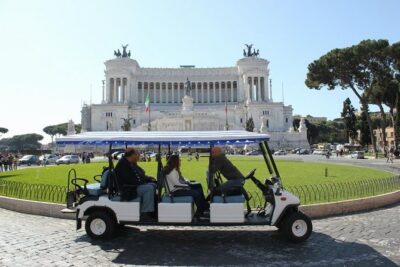
Rome by Golf Cart Private Tour: Beyond the Landmarks
Read our review →
Rome on a Golf Cart Semi-Private Tour Max 6 with Private Option
Read our review →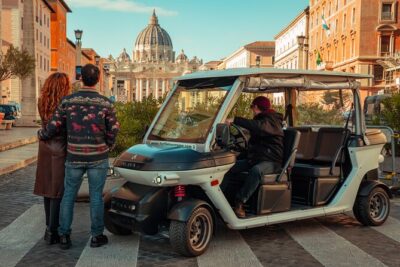
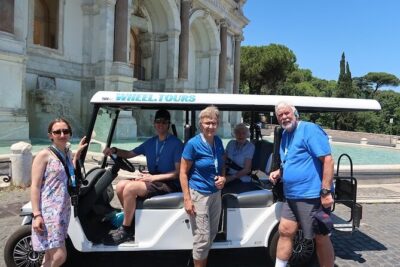
Rome Highlights City Tour by Golf Cart with Gelato
Read our review →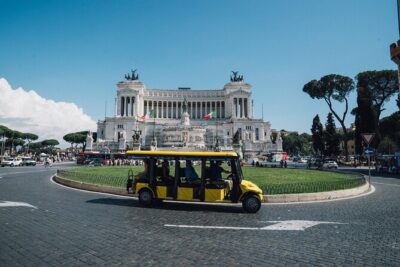
Golf Cart Small-Group Guided Tour: Rome City Highlights
Read our review →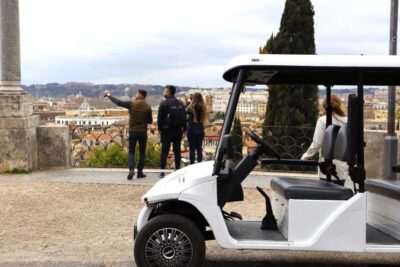
Private/Group 4 Hours Golf Cart SightseeingTour
Read our review →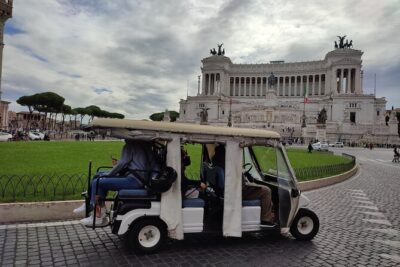
Browse the lists this tour appears in