
Reviewed · ROME
Caprarola: Villa Farnese, masterpiece of Renaissance architecture
Caprarola’s Villa Farnese is interesting because it feels less like a museum stop and more like stepping into a Renaissance power center. You get Vignola’s famous Scala Regia staircase, then move through rooms packed with 16th-century frescoes and grotesques that cover walls and ceilings. One possible drawback: the palace interior is mostly about paintings and architecture, so if you’re hoping for lots of period furnishings, you may find it visually spare.
The visit runs about 1 hour 30 minutes with an English-speaking guide and includes your entry ticket. It’s also set in a real town, not Rome, so plan for getting to Caprarola (near Viterbo) and enjoying the view from a dominant position over the surrounding area.
Key highlights before you go
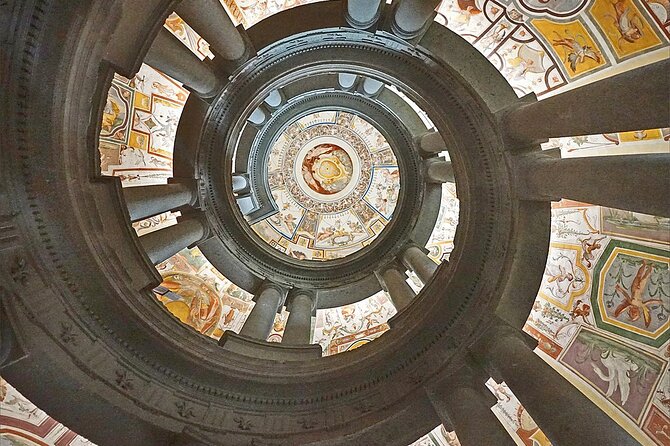
- Vignola’s Scala Regia staircase: dramatic design and a smart way to reach the main floors
- Sala degli Angeli (Hall of the Angels): the room’s acoustics make it memorable, not just pretty
- Frescoes across every room: classical and religious references, plus a huge scale of painted detail
- Renaissance garden walk: statues, fountains, chestnut woods, and cypress trees
- A strong local guide can change everything: the subject matter is easier to enjoy when it’s explained well
- You must be in Caprarola, not Rome: the name sounds Rome-adjacent, but the palace is about 60 km away
Palazzo Farnese in Caprarola: Renaissance architecture you can read with your feet
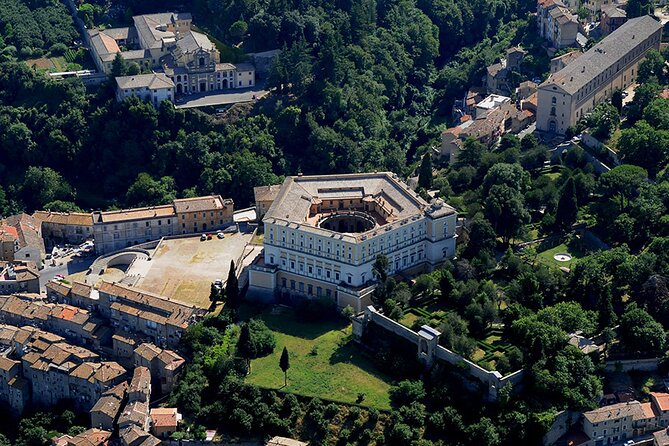
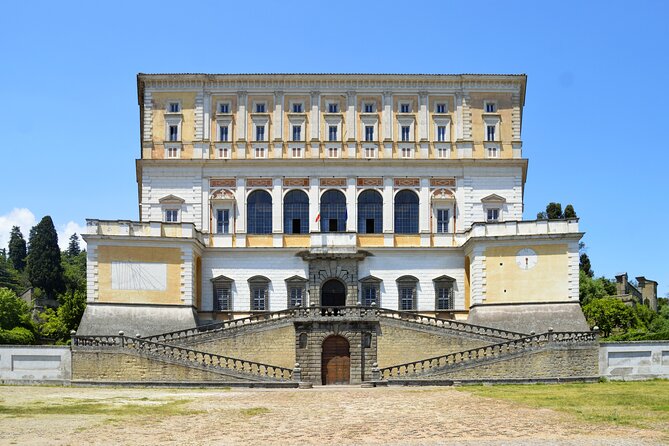
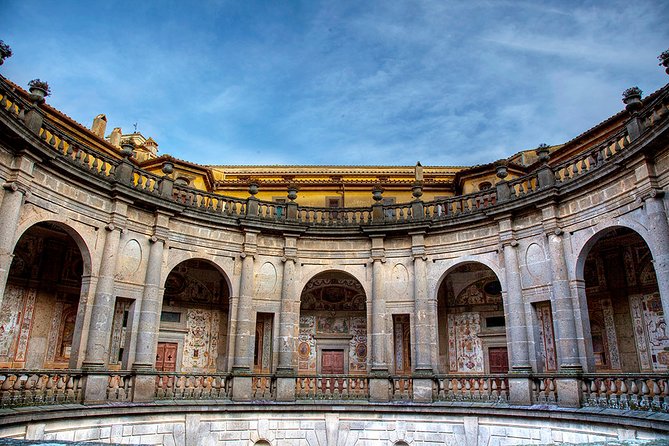
Palazzo Farnese (in Caprarola) is a late Renaissance mansion with the feel of a fortress. Externally, it comes across as imposing, almost defensive, then inside it becomes theatrical. That contrast is part of what makes this visit satisfying: you’re not only looking up at art, you’re also seeing how architecture staged authority.
The building is tied to the Farnese family and the 16th-century world they inhabited. The guide will point out how the whole plan and circulation makes sense for people moving between public rooms and private apartments. Even if you’re not a design geek, you’ll probably find yourself following the flow just to understand where you are and why it’s arranged this way.
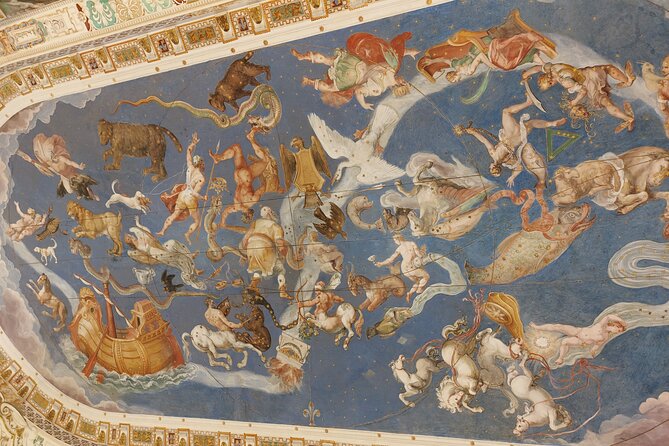
If you like visits that reward close looking, this one delivers. The ceilings and walls are covered with painted programs, including grotesques and scenes with both classical and religious references. And because there’s not much furniture inside, your eyes naturally go to the artwork and the structure.
Other things people book around Lake Bracciano:
- Civitavecchia Private Transfer: From the Port to Rome Airport
★ 5.0 · 309 reviews - Food Tasty and History Tour in Civitavecchia
★ 5.0 · 256 reviews - Civitavecchia Shore Excursion: Best of Rome Private Tour
★ 5.0 · 247 reviews
Finding the right address: Caprarola is not Rome
This is the practical gotcha for the whole experience. The palace is in Caprarola (near Viterbo), not Rome. Caprarola is about 60 km from Rome, so arriving in the wrong city can ruin the day.
Your meeting point is Via Filippo Nicolai, 1, 01032 Caprarola VT, Italy. The tour ends back at the same meeting spot. I’d treat that address like a destination, not a suggestion, and I’d double-check it against your maps app before you drive.
Also, give yourself buffer time. Streets in smaller Italian towns can be narrow, and it’s easy to lose minutes if you have to re-route. If you’re coming by car, parking and navigation matter more here than they do at bigger city sites.
Scala Regia and the state rooms: what you actually see in the guided portion
Inside Palazzo Farnese, the star move is Scala Regia, the great staircase designed by Vignola. Even if you’re not steeped in Renaissance architecture, you’ll feel why it matters. It’s a key connector in the building, used historically to reach the main-floor apartments tied to the Farnese household.
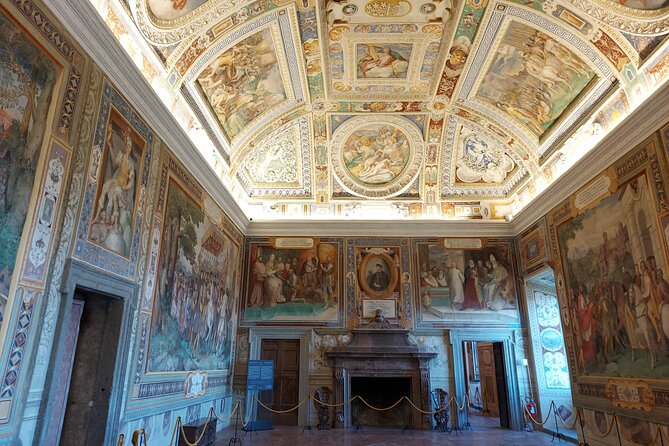
The tour also focuses on the main reception areas and the state rooms. This is where the fresco program gets serious. You’ll see decorations with a mix of motifs, including classical themes and religious references. The guide explains how the imagery fits together, rather than leaving you with a wall full of paintings that look impressive but random.
A highlight is Sala degli Angeli (Hall of the Angels). The room is known for echoing when you speak or move through it, so the guide may have you pay attention to the acoustics as part of the experience. It’s a small moment, but it makes the space feel alive.
One thing to set expectations: many rooms have little to no furnishings. The visual impact comes from the painting and the architecture, not from furniture you can admire. That can be a plus if you love art and design, and a letdown if you’re expecting something more like a dressed-up palace interior.
Interpreting the frescoes: why the subject matter isn’t just decoration
The frescoes here aren’t only for beauty. They’re for meaning. The painted cycles mix references that would have made sense in the 16th century, including classical storytelling and Christian symbolism. When you have a good guide, those references start to click, and the rooms stop feeling like wallpaper.
In particular, the guide’s job is to connect these artworks to how power was performed in that era. The Farnese name mattered, and the building is part of that statement. Even the way you move through rooms supports the message: public spaces lead into more significant areas, and key rooms make you pause.
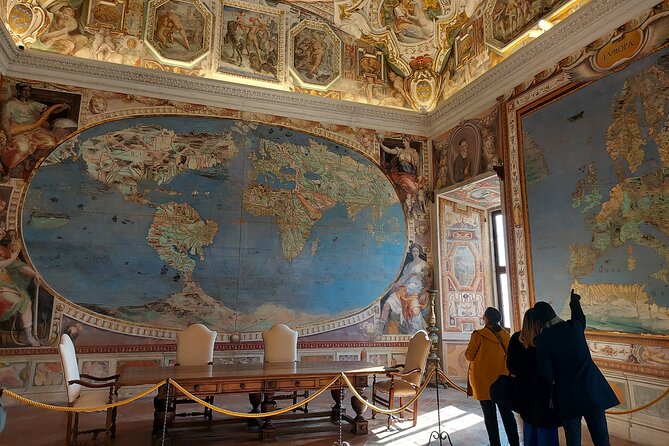
You’ll also get moments that feel like a breakthrough in understanding. One standout area is the room associated with the maps of the continents around 1573, which gives you a taste of the period’s worldview. Instead of only religious stories, you see how geography and knowledge were used as prestige. It’s the kind of room that can completely change your perception of what a Renaissance palace could be.
If you’re the type who likes reading the little labels and calling it a day, you might still enjoy this. But if you want the paintings to mean something, the guided format is a big part of the value.
Same city, a completely different kind of day:
- Civitavecchia Private Transfer from ship to FCO airport or Rome
★ 5.0 · 245 reviews - Civitavecchia Port To Rome City Centre
★ 4.0 · 171 reviews - Transfer from Civitavecchia port to Fco Rome airport or Rome
★ 4.5 · 155 reviews - Panoramic Tour of Rome by Bus from Civitavecchia
★ 4.0 · 138 reviews
The Renaissance gardens: your walk from the palace to upper views
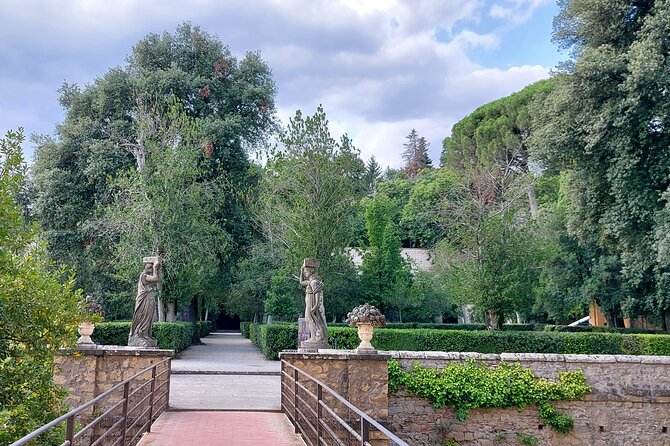
After the interior, you move into the Italian Renaissance gardens. Expect a one-way flow through paths that lead from the main palace area to outdoor spaces, including upper sections where you can see how the grounds are laid out. Gardens are part of the Farnese story here, not an afterthought.
The garden setting includes statues, fountains, chestnut woods, and cypress trees. In other words, it’s not just trimmed hedges and pretty paths. The woods and trees give a sense of shade and length, so the walk feels like a proper transition from the painted rooms to open air.
Practical note: some portions of the upper garden may be closed for restoration, and not every water feature may be running. You might hear that certain fountains or water effects can be out of service, depending on the day. That doesn’t ruin the visit, but it’s worth keeping in mind if you’re going mainly for water displays.
There’s also a smaller villa option at the end of the garden route. For many people, the effort of walking uphill is what makes the outdoor part feel rewarding, because the building dominates the area and the views give context to the palace’s strategic placement.
Price and value: when a guide is worth the money
This tour costs $138.16 per person and includes entry tickets to Palazzo Farnese in Caprarola. For a guided visit that lasts about 1 hour 30 minutes, it’s not a budget price, but it isn’t priced like a full-day excursion either.
Here’s how I’d judge value. A palace ticket alone can be fairly modest, and some visitors have cited around 10 euros for admission. The big difference is that your ticket on this format includes guided interpretation, which is crucial for fresco rooms that are dense with symbolism. If you’re standing in front of paintings without context, you can easily miss what makes them special.
Also, the tour is private, meaning only your group participates. That matters if you want questions answered at a normal human pace, not in a crowd shuffle. Add English instruction and a mobile ticket, and you’re getting a smooth, low-stress format.
One more value point from the experience: the best moments often come from the guide’s storytelling. In at least one visit, a guide named Serena was singled out for having a huge grasp of nuance and context, not just basic facts. If you’re lucky enough to get a similarly strong guide, you’ll feel the difference immediately.
Who should book Palazzo Farnese in Caprarola, and who might skip it
I think this tour is a great fit if you:
- love Renaissance art and want to understand what you’re seeing
- enjoy architecture as much as paintings, especially staircase design and room planning
- want an organized visit so you don’t have to piece together the building’s meaning on your own
- prefer a smaller, private-group experience rather than a big bus-queue situation
You might hesitate if you:
- only want easy, casual sightseeing with minimal walking and fewer stairs
- expect the palace to feel like a furnished home, with lots of decor beyond frescoes and structure
- get disappointed when gardens have closures or when fountains are not working that day
The good news is that most travelers can participate, so this isn’t built like an extreme physical challenge. It’s still a museum-palace experience, so you should expect stairs and indoor walking.
Should you book this tour?
Yes, if you want the frescoes and architecture at Palazzo Farnese to make sense while you’re inside the rooms. The combination of Vignola’s Scala Regia, Sala degli Angeli, and a guided explanation of the painted programs is what turns this from a quick viewing into a real experience.
I’d especially book if you’re the type who likes context. Without guidance, you’ll still see impressive decoration, but with it you’ll understand why those images were chosen and how they link to the Farnese story. The only caution is practical: arrive in Caprarola, not Rome, and use the exact meeting address so you do not lose your slot.
If you’re already touring the wider area around Lake Bracciano and Viterbo, this works beautifully as an off-the-radar stop that feels connected to the bigger Italian renaissance world, without feeling like you’re trapped in a city crowd.
FAQ
Where is the meeting point?
The meeting point is Via Filippo Nicolai, 1, 01032 Caprarola VT, Italy.
How long is the tour?
It lasts about 1 hour 30 minutes.
Is the tour in English?
Yes, it is offered in English.
What is included in the price?
The price includes entry tickets to Palazzo Farnese in Caprarola.
Is this a private tour?
Yes. It is listed as a private tour or activity, meaning only your group participates.
Will I get a mobile ticket?
Yes. The tour uses a mobile ticket.
What is the cancellation policy?
You can cancel for a full refund up to 24 hours before the experience starts.
Can most people participate?
The listing says most travelers can participate.
Recently reviewed around Lake Bracciano
- Civitavecchia shore excursion Best of Rome Colosseum and Vatican★ 5.0 · 105 reviews
- Tour in Rome : a mix of history★ 5.0 · 41 reviews
- VIP Best of Rome in 1 Day Guided Sightseeing Tour in English★ 5.0 · 36 reviews
- Transfer from Civitavecchia port to Fco Rome airport or Rome★ 4.5 · 155 reviews
- Transfer from the Port of Civitavecchia to Rome★ 5.0 · 15 reviews
- Transfers Civitavecchia Port★ 3.5 · 16 reviews
- Tour of the main attractions of ancient and modern Rome.★ 5.0 · 105 reviews
- Transfer from and to Airport – from and to Port – from and to hotel★ 5.0 · 30 reviews